Building a Technology Workflow Culture in Accounting Firms | CA Office Automation
Home Blog Workflow Culture

The New Leadership Challenge:
Building a Technology Workflow Culture
in Accounting Firms

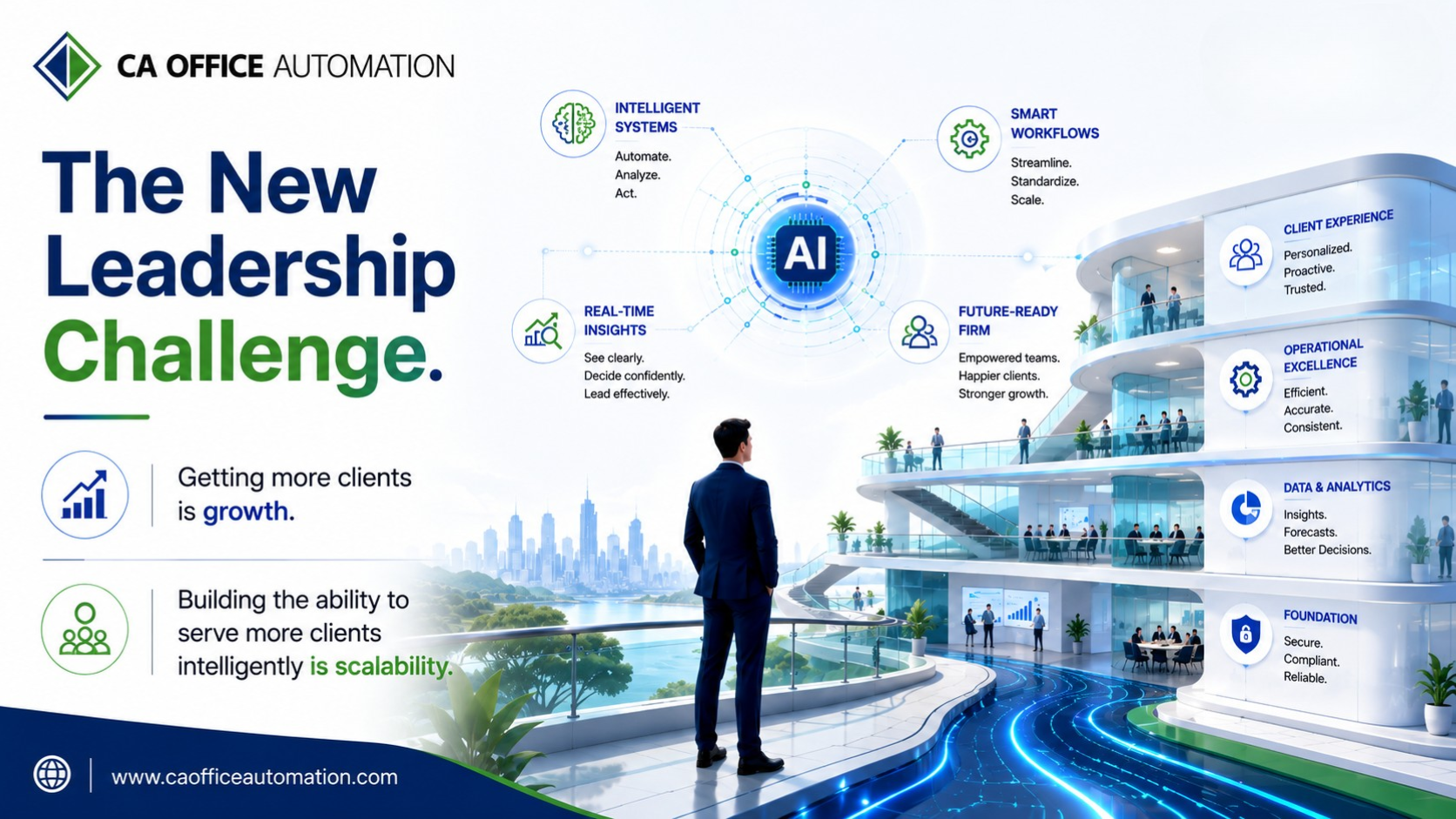
Getting more clients is growth. Building the ability to serve more clients intelligently is scalability. AI adoption is not just a technology project — it is a leadership responsibility.

Workflow Culture AI Leadership Scalable Growth
Building a Technology Workflow Culture in Accounting Firms

For years, the growth model of accounting firms has been relatively straightforward:

Get more clients → hire more people → handle more work.

But that model is becoming increasingly difficult to sustain.

As a CA or CPA firm grows, the number of clients, engagements, documents, deadlines, communications, approvals, and internal activities grows with it. If the firm's operating methods remain manual, growth can eventually create complexity faster than it creates value.

The next stage of growth requires something different: a Technology Workflow Culture.

Growth Is Not the Same as Scalability

Getting 500 new clients is growth.

Being able to serve those clients efficiently — without proportionally increasing administrative workload — is scalability.

This is where many accounting firms face a hidden challenge. A firm may have:

  • Excellent professionals
  • Strong client relationships
  • Good technical expertise
  • A growing sales pipeline

Yet internally, employees may still be managing work through spreadsheets, emails, WhatsApp messages, personal reminders, and disconnected documents. The firm is growing — but its operating system has not grown with it.

Your Firm Needs a Technology Workflow Culture

Technology adoption should not simply mean purchasing an ERP, CRM, or AI tool. The bigger question is: How does leadership want work to happen inside the firm?

A technology workflow culture means that leadership deliberately defines how work should move through the organization. For example:

Client Request → Task Creation → Assignment → Document Collection → Review → Approval → Delivery → Billing → Follow-Up

Instead of allowing every employee or department to manage this process differently, the firm establishes a standardized digital workflow. The system becomes the common way of working.

Leadership Must Design the Workflow

Traditionally, management focuses on questions such as:

  • Who is handling this client?
  • Is the work completed?
  • Why is this task delayed?
  • Did we send the reminder?
  • Has the client provided the document?

Technology-enabled leadership asks a different set of questions:

  • Can this task be automatically assigned?
  • Can the system identify the delay?
  • Can the client receive an automatic reminder?
  • Can the manager see the exception immediately?
  • Can AI assist with this process?
  • Can this information flow automatically to the next stage?

This is a fundamental shift. Leadership is no longer only managing people. Leadership is designing how people and technology work together.

Don't Make Employees Remember What the System Can Remember

Consider a common accounting-firm process — a client's document is pending.

Traditional Environment
  • Employee remembers
  • Employee sends WhatsApp
  • Employee sends email
  • Employee follows up
  • Manager asks for status
  • Employee checks manually
Smart Workflow
  • System identifies pending document
  • Automated reminder sent
  • Automatic follow-up
  • Escalation if overdue
  • Manager sees exception instantly

The employee is still responsible for the relationship and professional judgment. But the system manages the repetitive coordination. That's smart work — not simply faster work.

AI Makes the Workflow Even More Powerful

Workflow automation has existed for years. AI introduces another layer. Instead of software only following predefined rules, AI can assist with tasks that require understanding information and context.

For example:

Email Agent
Reads incoming communications, identifies important requests, prepares responses, and can initiate appropriate workflow actions.
Document Analysis Agent
Analyzes documents, extracts information, and helps professionals understand large volumes of content.
Data Insight Agent
Interacts with firm data and surfaces operational insights to support leadership decisions.
AI Chat Agent
Allows employees to ask questions about firm processes, information, and operations using natural language.
Communication Agent
Supports client communication, reminders, and routine interactions automatically.
Workflow Agent
Monitors tasks, deadlines, pending activities, and operational bottlenecks across the firm.

These digital workers don't replace accountants. They reduce the amount of repetitive operational work accountants have to perform manually — freeing human expertise for what matters most.

The New Accounting Workplace: Humans Digital Workers

The future accounting office will increasingly consist of two types of workers.

Human Professionals
  • Professional judgment
  • Technical expertise
  • Advisory services
  • Client relationships
  • Complex decision-making
  • Review and approval
Digital Workers
  • Follow-ups & monitoring
  • Document analysis
  • Client communication
  • Data processing & reporting
  • Workflow coordination
  • Routine information retrieval

The objective isn't to automate human expertise. It is to protect human time for work where human expertise creates the most value.

Smart Work Culture Starts With Leadership

Technology culture doesn't happen because software is installed. It happens when leadership establishes expectations.

Instead of: "Please maintain your own Excel tracker."
Leadership says: "All work must be tracked through the firm's central workflow."
Instead of: "Remember to follow up with clients."
Leadership says: "Routine follow-ups should be automated wherever possible."
Instead of: "Send me an update every evening."
Leadership says: "Management should have real-time visibility through the system."
Instead of: "Use AI whenever you need it."
Leadership says: "Use AI within the firm's governed and secure AI environment."

This is how technology becomes part of the firm's culture.

New Client Acquisition Is Only One Part of Growth

Accounting firms understandably focus heavily on acquiring new clients. But acquiring a client is only the beginning. The real business challenge is: Can your firm serve that client efficiently for years?

As client numbers increase, firms need systems capable of handling:

  • More engagements & documents
  • More deadlines & communications
  • More billing & employees
  • More approvals & operational complexity

Without technology-enabled workflows, growth can eventually increase administrative burden faster than revenue. Growth brings clients. Technology makes growth scalable.

Build a Tech-Savvy Office Before You Need One

A technology-savvy CA or CPA firm doesn't mean every employee needs to be a technology expert. It means the firm's processes are designed around technology. A modern accounting office should progressively build:

1
Centralized Practice Management
2
Digital Document Management
3
Standardized Workflows
4
Automated Follow-Ups
5
Real-Time Management Visibility
6
AI-Assisted Operations
7
Digital Workers

This creates a foundation for continuous improvement.

Technology Should Remove Friction, Not Add It

One of the biggest mistakes firms can make is implementing technology without redesigning their processes. Adding another application can sometimes create more complexity. The objective should be the opposite.

Employees should have:

  • Fewer places to check
  • Fewer things to remember
  • Fewer repetitive activities
  • Fewer manual follow-ups
  • Fewer disconnected systems

Good technology should make the right way of working the easiest way of working.

From Management to Intelligent Orchestration

The role of a partner or managing director is also evolving.

The traditional question is: "Are my people working?"

The modern question is: "Is my operating system helping my people work effectively?"

This includes understanding:

  • Which processes should be standardized
  • Which activities should be automated
  • Where AI can assist
  • Where human approval is necessary
  • Where bottlenecks are occurring
  • How information flows across departments
  • How technology can improve client experience

Leadership therefore becomes the driving force behind the firm's digital transformation.

CAOA: Creating a Technology-Enabled Accounting Workplace

CA Office Automation (CAOA) is designed specifically for accounting service providers to bring practice management, workflows, documents, communication, data, and AI together. CAOA helps firms move toward a technology workflow culture through:

Practice Management
Task & Workflow Management
Document Management
Automated Notifications
Client Management
Billing & Invoice Automation
AI Agents
Data Insights
AI-powered Communication
Governed AI
Local and Cloud LLM support

The objective is not simply to give accountants another software platform. It is to create a digital operating environment for the entire firm.

The Future of Accounting Leadership

The accounting firm's competitive advantage will increasingly depend on more than technical expertise and client acquisition. It will depend on how intelligently the firm operates.

The leaders who think beyond "How many clients can we acquire?" and start thinking "How intelligently can we serve them?" will build firms that are more scalable, productive, and resilient.

The next generation of accounting leadership will be about creating the right balance between:

People   +   Process   +   Technology   +   AI
Final Thought

Getting more clients is growth Building the ability to serve more clients intelligently is scalability.

A smart accounting firm doesn't simply hire more people every time its workload increases. It builds better workflows. It automates repetitive work. It gives professionals better information. It uses AI where AI adds value. And most importantly, it creates a culture where technology is part of how the firm works — not something the firm occasionally uses.

AI adoption is not just a technology project. It is a leadership responsibility. And the firms that build a technology workflow culture today will be better prepared to lead the accounting profession tomorrow.

"CA Office Automation — Building the Intelligent Practice Management Platform for Modern CA & CPA Firms."
Book Free Demo Talk to Our Team
Share this article: X LinkedIn Facebook
What Our Users Say

Loved by Accounting Firms Worldwide

Join thousands of CAs and accounting professionals who have transformed their practice with CAOA.

"Hearty congratulations to the team at CA Office Automation for an excellent job! We've been trying to put together a functional Office Automation system for the last three years. They've worked closely with us throughout the process, staying on task, on target, and on budget."

FK
Felix K Kimoli
MGI Alekim LLP, Kenya

"CAOA transformed how we operate. The intelligent workflows alone eliminated hours of daily coordination. Our team now focuses entirely on advisory work — not chasing documents or sending reminders."

S
Sunita Kapoor
Kapoor & Partners

"We thank the CAOA team for the wonderful job they are doing in helping us develop our internal control system. Everyone has been professional, excellent and hard-working. Thanks to them, we were able to achieve our goal on time."

P
CPA Pankaj Mankani
RVG Accountants, Dubai, UAE
Keep Reading

Related Articles

Build Your Workflow Culture

Ready to Make Your Practice
Truly Scalable?

See how CAOA's practice management platform, intelligent workflows, and AI agents help CA & CPA firms build a technology workflow culture from the ground up. Book a free 30-minute demo today.

Explore More from CAOA